There was a buzz on the streets of Jerusalem as pilgrims flocked to the city for Passover. Rumors swirled that the Messiah could possibly be there. But those rumors were being fed by the fact that a man named Lazarus was there as well.
Yes… THAT Lazarus.
 The dead guy.
Word of the miraculous resurrection of this man from Bethany had already spread like wildfire. Just weeks before, Lazarus was lying dead in a tomb.
Stone. Cold. Dead.
When Jesus showed up, His presence did little to dissuade their sorrow. Even before He made it into the village proper, Lazarus’s sister Martha came out to meet Him.
“Lord, if You would have been here my brother would not have died”, Martha exclaimed, probably in mid-stride.
Mary, Lazarus’s other sister, waited until Jesus got to town before she fell at his feet, echoing the same exclamation of hopelessness. The display of genuine mourning moved Jesus, in spite of the fact that He knew what the outcome of the day would be. Although God, He was human as well, and subject to human emotions such as sorrow. Lazarus had been His friend, and although the irony of the moment was not lost on Him, He also was not immune to its emotion either.
“Remove the stone”, came the command from the Master upon arriving at the entrance to Lazarus’s tomb.
“But Lord… he’s been in there for four days! What about the stench???” inquired the always practical Martha.
Again with the doubting????
“Did I not say to you that if you believe, you will see the glory of God?” Jesus’ tone with His reply made them think better of asking any more questions. They rolled the stone away, and after lifting His eyes to the heavens in a brief prayer of thanksgiving to the Father, Jesus set His focus on the opening before Him.
“Lazarus! Come forth!” Jesus commanded into the darkness of the cave.
Moments later, a grave-linen-clad Lazarus appeared within sight of all who were gathered there.
Even in first-century Judea… news traveled fast.
Now Jesus is in Jerusalem, Lazarus is there, and the subsequent attention that both were attracting was not all positive. While the rumors of the Lazarus miracle had attracted the attention of certain Greek converts with a fired-up desire to see Jesus, the religious crowd had other plans.
Now a great many of the Jews knew that He was there; and they came, not for Jesus’ sake only, but that they might also see Lazarus, whom He had raised from the dead. But the chief priests plotted to put Lazarus to death also, because on account of him many of the Jews went away and believed in Jesus. ~ John 12:9-11
So… Lazarus has died, Jesus shows up four days later and raises him from the grave, the people are now flocking to Jesus in droves, and your big plan is to kill the guy Jesus just raised from the dead???
Really?!?!
Maybe if they had spent as much time studying the prophecies as they did in scheming and plotting, they would have realized what Jesus then revealed to these Greek converts — a traditionally scholarly bunch.
“The hour has come that the Son of Man should be glorified. ~ John 12:23
In this statement was a huge paradigm-shift. Up until this point, Jesus had — on multiple occasions — declared the opposite; “My time has not fully come” was the reason given on more than one occasion and for more than one reason. But now He was declaring that His hour HAD come!
But what hour?
Jesus understood that the hour had come for the season to be realized.
While the priests were busy plotting against the diversion of the Lazarus conspiracy, every prophecy about Jesus was falling into place. All of the prophetic chess pieces were falling into place, and the Pharisees and chief priests were mere pawns.
The prophecy about His death was about to be fulfilled.
All of the typology of His passion was about to be understood.
The stranglehold that Satan had on the human race was about to be broken.
Jesus understood that His entire life had led up to this moment; the whip, the garden, the betrayal, the mocking, the crown of thorns, and the cross. His entire life on this earth had been a road to the cross. Before time began, God knew of humanity’s fall, and had His kingdom planned (Matt. 25:34), His people chosen (Eph. 1:4), His salvation finished (Heb. 4:3), and the cross and the redemptive blood of Christ planned (1 Pet. 18-20). As the saying goes… “it was over before it started.”
Jesus understood that the hour had come for the seed to be sown.
Most assuredly, I say to you, unless a grain of wheat falls into the ground and dies, it remains alone; but if it dies, it produces much grain. ~ John 12:24
Jesus saw the giving of His life in harmony with the ancient principles of seed-time and harvest. He was not forfeiting His life. He was giving His life. It was not martyrdom but rather an investment. As Lord of Creation, He understood the Laws of the Harvest…
You must sow to reap.
In order to get a harvest, you must first plant seed (John 3:14-15)
You reap what you sow.
Jesus sowed righteousness to release a resurrection life.
You reap after you sow.
Jesus knew what was coming, and knew what He had to do (Heb. 12:2).
You reap more than you sow.
Just as a single seed births an apple tree that produces thousands of apples, Jesus sowed His life, and reaped a new human race.
Jesus understood that the judgment being executed was not His execution.
Jesus knew going into His crucifixion that the real judgment was not the one handed down by Pontius Pilate, but was the two-fold judgment being sealed by His death on the cross.
 Everything the human race was and is in Adam was judged on the cross. (Rom. 5:18)
Jesus knew that all of the history of mankind until that moment was being judged at that moment, and that, in three days, everything would be different.
Satan’s judgment was assured. (Col. 2:14-15)
Satan was “the prince of this world”. He was the cherubim over all the planet earth until his fall. In Eden, he tried to regain what he had forfeited. At the cross, his infernal plans were thwarted once and for all, and he was stripped of his authority.
Jesus understood the attraction of the cross.
And I, if I am lifted up from the earth, will draw all peoples to Myself.”
This He said, signifying by what death He would die. ~ John 12:32-33
The cross was an ugly thing. It was one of the most diabolical methods of torture and death ever devised by men. All along, Jesus knew it was coming. Yet, because of Jesus death, that very cross — repulsive to the Jews and a cause of scandal to the Greeks — had a drawing and saving power no one can explain.
They still can’t.
The cross is more than two ugly wooden timbers fastened together, or a piece of beautiful jewelry to be worn. The cross is the crossroads of human history — the focal point that every moment before pointed to, and every moment since is dependent upon.
You see, the Cross is:
“of all times the turning point;
of all history the crucial point;
of all love the highest point;
of all salvation the starting point;
of all worship the central point.”

 For many of us who are sports fans, we just witnessed a historic event. In Super Bowl LI, we watched as the New England Patriots — who were down by 25 points at halftime — came back to win the Vince Lombardi Trophy for the 5th time in a stunning overtime defeat of the Atlanta Falcons. Never before had a team overcome more than a 10-point deficit in the Super Bowl. Never before had “The Big Game” gone into overtime. When the New England Patriots came out of the locker room for the 3rd quarter, it looked like it was all but over. I had friends who actually turned off the game because it looked like such a blowout. “On to other things.” So what happened?
 According to the website
 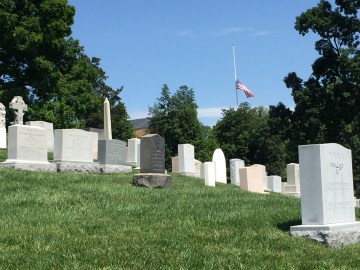 Visiting Arlington National Cemetery is an experience I would recommend to any American citizen. Overlooking our nation’s capitol, Arlington is the final resting place for American heroes, patriots, presidents, and other notable figures throughout our history. Among those laid to rest in Arlington are Presidents Kennedy and Taft, Governor Earl Warren, astronaut Capt. Pete Conrad, explorer Robert Peary, Supreme Court Justice Thurgood Marshall, and civil rights activist Medgar Evers.
 Established in 1921, the Tomb of the Unknown Soldier is the resting place of three unknown American soldiers… one from each of the wars; World War I, World War II, and the Korean War. While there had been one unknown from the Vietnam War, that body was later exhumed and identified through DNA as Air Force 1st Lt. Michael Joseph Blassie. The Vietnam War crypt now remains vacant.
 Guarded non-stop since July 1, 1937, the sentinels guarding the tomb are committed to the respect and reverence a place of such hallowed distinction deserves. From their 8 hours of uniform preparation prior to every shift, to the precision of every movement, to their unwavering dedication in the face of heat, cold, and inclement weather, these soldiers dedicate their time of service to the physical and symbolic protection of the Tomb.
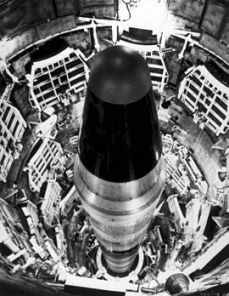 On September 18, 1980, at approximately 6:00p.m., an Air Force PTS team (Propellant Transfer System) entered the Titan II Missile Complex 374-7 in Damascus, Arkansas. Their purpose for being there was to replace a small part on the missile. At about 6:25p.m., a two man team went into the missile silo to work on the missile.
 The Titan II intercontinental ballistic missile stood approximately 7 stories high, weighed around 330,000 pounds (165 tons), and carried the most powerful and destructive weapon in the history of warfare in the United States (possibly the world); a nine-megaton thermonuclear warhead that had three-times the destructive capability of every bomb dropped by every army during World War II combined, including the two atomic bombs dropped on Hiroshima and Nagasaki, Japan. This was a weapon with the capability to wipe out — not just a city — but a civilization.
 Now think about it. This catastrophe was caused because a small, eight-pound socket — something a minuscule fraction of the size of the missile — was accidentally dropped. And all it took then was for the tiniest spark to ignite the leaked fuel for the entire facility to turn into a deadly inferno.
 A tiny bit controls a thousand-pound horse. A tiny rudder steers a massive ship on the wild sea. Thousands of acres of forest can be set ablaze by an unattended campfire or a carelessly discarded cigarette butt.
 Whether it is how you whisper to a child, speak to a friend, orate to a large gathering, or proclaim from the mountaintop through media… words have meaning. Words have consequences. Words can be a fountain of life, or a weapon of destruction. Words are more than just mindless blathering… they are the reflection of the deepest recesses of the heart. Jesus drove this point home when He said…
 Maybe your words have already harmed another. Maybe, because of something you said, the elements are already in motion, counting down to an inevitable explosion. It’s not too late! Just as words of anger, jealousy, and malice can set the potential disaster into motion, words of forgiveness, healing, and contrition can avert that same disaster. It just takes the putting down of pride and the willingness to be the “bigger” person; to be righteous instead of “right”. It just takes putting on the mind of Christ, and being an agent of peace and unity instead of chaos.
 In about two weeks, America will once again go through the pomp and ceremony of inaugurating a new president, meaning new leadership and new direction in our nation. While January 20 (and a few days following) will be filled with all manner of spectacles, traditions, and commentary, it will merely mark the beginning of an administration that came to power on promises of ending corruption, national security, and returning us to being a nation “of, by, and for the people.” President Trump will have his hands full, leading our country during a time of political unrest, social division, international instability, and unfettered terrorism.
 Prayer is not partisan. While I never voted for President Obama, and disagreed with him on much of his agenda, I prayed for him nearly every single day. I genuinely hoped and prayed that he would be a good and just president. My prayer is the same for President Trump. I pray that he will surround himself with Godly counsel, that he will listen to wise advisers, and that he will always put America’s best interests — spiritually, socially, and economically — first (this includes an unwavering support for Israel).
 Last, I would encourage all of us — as Americans — to be diligent in seeking after holiness, righteousness, and decency. Make a difference in your own circle of influence. Last year, I wrote a book called
  America! America!
 So it was, when the angels had gone away from them into heaven, that the shepherds said to one another, “Let us now go to Bethlehem and see this thing that has come to pass, which the Lord has made known to us.”
 Every morning (weather permitting), the old artist would walk down the hill from his house to the small dock he had built years before on the lake. He would take his easel and a small box of drawing and painting utensils, and spend hours sitting on the dock, painting and sketching. Often, he would paint his beautiful surroundings — trees, water, the mountains, the woodland creatures — but every once in a while, he would paint images from his mind, and what the serenity of that place inspired in his imagination. He started off just hanging the pictures in his small home but over time, the lack of wall space and the encouragement of a friend inspired him to sell his paintings at a local store. Every once in a while, his art would inspire him to accompany the painting with a poem from his own experience, and although he rarely wrote such poems, they were always filled with beautiful imagery, witty humor, and profound wisdom.
 For the first six months, his work was incredible. The publisher was overwhelmed by the beauty of the old artist’s eloquent and witty poems and stories. Furthermore, he was overjoyed by the public reception of the old artist — letters and correspondence praising the writings as masterful and insightful. Readership was up for the first time in a decade, with a corresponding rise in revenue. Everyone at the publishing company was happy.
 That place I call home. That place I knew since I was a young boy. That place I shared with the love of my life — my other inspiration — until her time on this earth was done. That place where the wind sings to my spirit, that holds my memories, my laughter, my tears, my joys, and my sorrows. That place that inspired adventure in a young man, and soothed the broken heart of a grieving and lonely old man.
 How many times do we see someone for what they are, but we miss who they are? How many times have we — as friends, acquaintances, leaders, and employers — looked to someone to fill a role in our lives without considering what it is that makes them qualified or even necessary to fill that role? How many times have employers, for the sake of gaining an employee, forsaken an artist? We see how having the abilities of a person can benefit us, but what is that thing that inspires them, that makes them who they are, that makes them of benefit to everyone around them? While we may choose what a person’s assignment is, do we understand what their anointing is?
 This Christmas season, I encourage you — actually, I invite you — as we celebrate the story of the Christ Child, to find out someone else’s story. Find out what makes them tick. Look beyond the temporal and temporary exterior and find out about their experiences, dreams, and aspirations.
 The Heart of Abba - Ron Phillips